
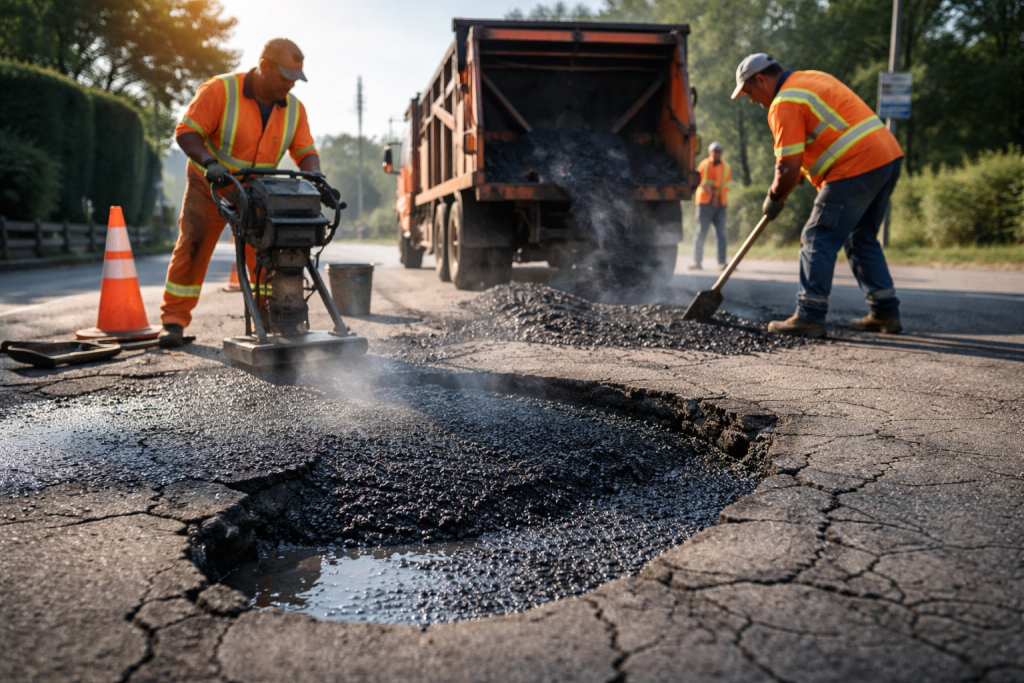
If you’ve ever patched a pothole only to watch it crumble again a few weeks later, you already know the uncomfortable truth: the “right” repair method depends on why the pothole formed, how much traffic hits it, and how much moisture is lurking underneath. Some fixes are designed to restore the pavement structurally. Others are meant to buy time.
This guide improves on the usual “here are your options” list by showing what each method is best at, what makes it fail, and how to choose a repair that holds up—especially for parking lots, commercial drives, and high-use surfaces.
What is a pothole repair trying to fix—surface damage or a base failure?
A pothole is rarely just an ugly surface defect. In many cases, it’s the end result of water intrusion + traffic loading + weakened asphalt/base—often accelerated by freeze-thaw cycles. Once water gets into cracks and the underlying layers lose support, traffic breaks the surface apart and the hole grows.
That’s why the same repair material can perform very differently depending on the site:
- Surface-only distress (small, shallow) → a localized patch may hold well.
- Base failure (soft, wet, pumping, crumbling edges) → the patch is only as strong as what it sits on, so quick fixes repeat.
A good repair choice is really a decision about how much of the pavement system you’re restoring, not just what you’re filling the hole with.
What are the main pothole repair options—and what is each one best for?
Most pothole repairs fall into a few core approaches used across the industry, from public roads to private lots.
1) What is traditional hot-mix patching—and when is it the best choice?
Traditional (hot-mix) patching typically involves:
- removing loose/failed asphalt,
- preparing the hole and base,
- placing hot-mix asphalt,
- compacting properly.
When it’s done with good prep and compaction, hot mix is often the best balance of durability and cost for many commercial lots and drive lanes—especially in warmer paving seasons.
Best for: medium-to-large potholes, higher-traffic areas, and repairs where longevity matters.
Common failure point: insufficient prep (dirty/wet hole, weak base, poor compaction).
2) What is infrared patching—and why can it look and perform “seamless”?
Infrared patching heats the existing asphalt so it can be reworked and blended with new material, creating a thermal bond rather than a cold seam. This is why it’s often favored when appearance and smoothness matter—especially in customer-facing areas.
Best for: surface distress and potholes where you want a smoother transition and reduced joint lines.
Common failure point: if the underlying base is failing, infrared can’t “fix” that—base issues still need structural repair.
3) What is cold patching—and when is it the right move?
Cold patch is pre-mixed material used without hot plant mix—ideal when you need a fast repair or when hot mix isn’t practical (weather, access, timing). Cold mix performance varies widely by product and conditions, and agencies/industry research shows that materials and procedures strongly influence durability.
Best for: temporary repairs, winter or wet-season response, low-to-moderate traffic areas.
Common failure point: placing cold patch into water/ice or failing to compact well; also product workability and durability differences matter.
4) What is “throw-and-roll”—and why is it popular even if it’s not the longest-lasting?
Throw-and-roll is exactly what it sounds like: place material, then compact by rolling (often with a vehicle) to get quick density. It’s fast and productive, which is why it’s widely used in reactive maintenance.
Best for: quick serviceability when downtime must be minimal.
Common failure point: limited prep and inconsistent compaction = shorter life than more “semi-permanent” methods.
How do you choose the right pothole repair method for your parking lot or roadway?
Use this decision filter (it prevents the most expensive mistake: paying for repeat patches):
Choose a faster, temporary method when:
- It’s cold/wet season and you need a safe surface immediately.
- The pothole is small/shallow, and the area is scheduled for resurfacing soon.
- You’re managing risk (trip hazards, vehicle damage) until a permanent repair window opens.
Cold patch or throw-and-roll often fits here—done correctly and compacted well.
Choose a longer-lasting repair when:
- The pothole is reoccurring in the same spot.
- Edges are raveling/crumbling, the hole is deep, or you see signs of soft base.
- The area takes turning traffic (entrances, intersections, dumpster pads, loading zones).
Hot-mix patching or an approach that restores structure is typically the better value in high-stress areas.
Choose infrared patching when:
- You want a clean, blended finish (especially in visible areas).
- The issue is largely localized in the asphalt layer rather than deep base failure.
- You want to reduce seam-related weak points where water can get in.
Why do pothole patches fail early (even when the material seems “fine”)?
Early failure is usually about process, not just product.
Common causes called out in best-practice guidance include:
- Water or debris left in the hole before placement
- No edge preparation (patch placed over crumbling asphalt)
- Inadequate compaction
- Underlying base still wet/weak (the patch has no support)
If you’re seeing repeat failures, the fix is often: upgrade the repair method OR upgrade the preparation steps (or both).
What preventive maintenance reduces potholes the most?
Potholes thrive on one thing: water getting into the pavement structure. Preventive maintenance focuses on blocking that pathway and keeping the surface strong.
High-impact prevention typically includes:
- Crack sealing to stop water intrusion before winter and heavy rains.
- Sealcoating (where appropriate) to reduce oxidation and surface wear.
- Drainage corrections so water doesn’t sit and infiltrate the same areas repeatedly.
- Timely patching of small failures before traffic turns them into full potholes.
FAQ
Is cold patch ever considered a “permanent” pothole repair?
Usually, it’s best viewed as temporary or seasonal, though performance improves significantly when crews follow good prep/compaction practices and use higher-performing mixes.
Can you repair potholes in winter?
Yes—this is one reason cold patch and quick methods exist. The key is setting expectations (often a “make it safe now, make it permanent later” plan).
What’s the biggest sign I need more than a simple patch?
If the pothole keeps coming back in the same spot, or the area feels soft and breaks apart quickly, you’re likely dealing with base failure or water intrusion, which requires a more structural approach.
Does infrared patching work on every pothole?
Infrared is excellent for many asphalt-layer issues, but it can’t magically stabilize a failing base. If the support layers are compromised, you’ll need deeper repair.
Why does compaction matter so much?
Compaction is what gives a patch strength and helps keep water out. Poor compaction leaves air voids and weak spots that traffic can break apart quickly.
Conclusion
A pothole repair isn’t just “fill the hole.” The repair that lasts is the one that matches the problem: temporary methods (cold patch, throw-and-roll) restore safety fast, while more durable methods (hot mix patching and well-suited infrared applications) are better when you need longevity and fewer repeat visits. The biggest cost saver is choosing correctly the first time—based on traffic, moisture, depth, and whether the base is failing.
Why HS&C Pavement Maintenance is Your Ideal Choice for Pothole Repair?
HS&C Pavement Maintenance doesn’t treat potholes like a one-size-fits-all problem. The team evaluates what’s actually happening—surface failure vs. base failure, drainage conditions, traffic stress—and recommends the method that fits your site and timeline, not just the fastest patch.
With decades of pavement experience and multiple repair approaches available (including traditional patching, infrared patching, cold patching, and throw-and-roll options), HS&C can build a plan that reduces repeat failures and helps you spend money once—rather than paying for the same pothole over and over.
Contact HS&C Pavement Maintenance to Fix Potholes the Right Way
If you’re dealing with recurring potholes, high-traffic damage, or you just want a repair plan that actually holds up, reach out to HS&C Pavement Maintenance for an assessment and repair recommendation tailored to your pavement’s conditions and budget.