
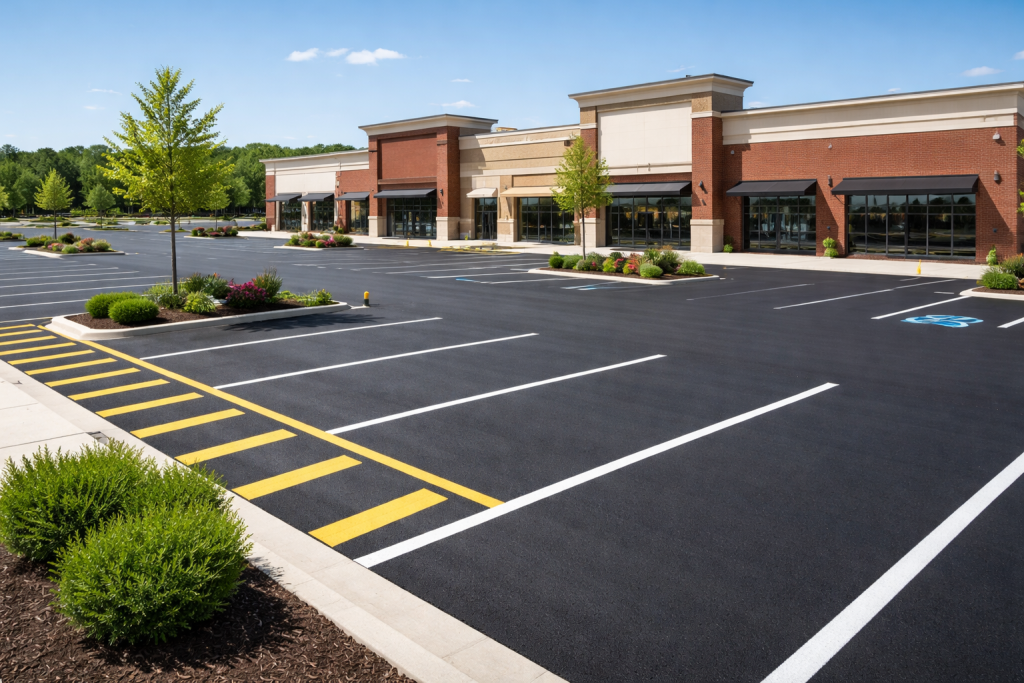
Southern Illinois businesses compete on details customers notice immediately: how easy it is to pull in, park, walk to the door, and feel safe doing it. Your asphalt—parking lot, drive lanes, loading zones, and walk paths—quietly influences all of that. When it’s smooth, well-marked, and draining correctly, it signals “this place is managed.” When it’s cracked, potholed, or confusing to navigate, it can create friction before a customer ever reaches your front counter.
Below is a revised, more complete version of the original post—built to help business owners understand the business case for asphalt paving (and how to approach it strategically).
Why do first impressions start in the parking lot?
Because the parking lot is often the first “touchpoint” customers experience—and it’s one of the few that communicates quality without a single word.
A clean, even asphalt surface tells people:
- you maintain your property,
- you care about safety,
- you’ve invested in a consistent customer experience.
The opposite is also true. Cracks, standing water, and potholes create a subtle (and sometimes not-so-subtle) message: “Things here might be neglected.” In high-competition areas—retail, medical, banking, restaurants, multi-tenant commercial—those small signals can affect whether someone returns.
How does quality asphalt improve accessibility and reduce liability risk?
It improves accessibility in two ways: physical access and predictable navigation.
- Safer walking surfaces
Accessible routes and general walking areas should be stable, firm, and slip-resistant—especially near entrances, ramps, and accessible parking. Poor pavement conditions can undermine that expectation and raise risk. - Better ADA-aligned parking function
Accessible parking needs to connect to the shortest accessible route to an accessible entrance. A well-planned, clearly marked lot makes it easier to comply—and easier for customers to use confidently. - Fewer trip-and-fall and vehicle incidents
Cracking, raveling edges, and potholes don’t just look bad—they create real hazards. Consistent paving, patching, crack sealing, and line striping reduce surprise conditions and help traffic flow make sense (especially at night or during bad weather).
What does asphalt paving change about day-to-day operations?
A parking lot isn’t “just parking.” It’s also:
- a delivery system (customers arriving and leaving),
- a logistics system (vendor trucks, waste hauling, loading zones),
- a safety system (pedestrian paths, fire lanes, emergency access).
When asphalt is designed and maintained as part of operations, businesses often see benefits like:
- smoother customer turnover and less congestion,
- fewer blocked entrances from puddling/ice,
- better use of space through optimized layout and striping,
- less disruption from emergency repairs.
In other words: good pavement reduces operational friction.
Why can asphalt paving lower long-term costs instead of increasing them?
Because pavement spending is usually cheapest when it’s planned, not reactive.
A “fix it when it breaks” approach tends to create:
- frequent patching,
- faster deterioration,
- higher downtime,
- larger sections requiring reconstruction sooner.
A more cost-effective approach is life-cycle thinking—investing at the right time to extend service life and avoid expensive full replacement. The Federal Highway Administration highlights life-cycle cost analysis as a way to compare alternatives over time, rather than focusing only on initial cost.
And preventive maintenance programs are widely taught and used because they help agencies and owners understand how earlier interventions can protect the asset and improve cost/benefit outcomes.
Practical takeaway for business owners:
Small issues (cracks, drainage problems, early potholes) are cheaper to address early. The longer they remain open, the more water intrusion and base damage you risk—especially through freeze-thaw cycles.
What are the most common signs your lot needs resurfacing or repair?
Here’s a quick business-owner checklist:
- Alligator cracking (web-like cracks): often a base failure indicator.
- Potholes recurring in the same areas: suggests underlying structural issues.
- Standing water after normal rain: drainage or grade problems.
- Edges breaking apart: often from traffic, weak base, or lack of support.
- Faded striping + confusing traffic flow: creates safety and customer-experience problems.
- Multiple “patch-on-patch” areas: a sign the surface is at the end of its cost-effective repair life.
If you’re seeing several of these, it’s usually time for a more strategic evaluation—patching alone may not be the best ROI.
How can asphalt paving support sustainability goals without sacrificing performance?
Sustainability isn’t only about materials—it’s also about resource efficiency over time.
- Asphalt is highly recyclable
The asphalt industry routinely reuses reclaimed asphalt pavement (RAP) and other recycled inputs in new mixes, supporting a circular approach. - Permeable pavement options can reduce stormwater impacts
Where appropriate (and engineered correctly), permeable pavement systems can help reduce runoff impacts and improve stormwater management performance compared with traditional impervious surfaces. EPA research has studied permeable pavement in parking lot settings specifically for stormwater management outcomes.
USGS also explains how permeable pavement can capture precipitation/runoff and allow infiltration, reducing runoff volume and potentially improving water-quality outcomes.
Important note: Permeable systems aren’t ideal for every site (soil, traffic loads, winter maintenance, and drainage design matter). But sustainability conversations today are broader than “recycled content”—they include water management, longevity, and reducing disruptive rebuild cycles.
What’s the smartest way to plan an asphalt paving project for a business?
A paving project goes best when it starts with a plan—not a price.
A practical planning sequence:
- Define how the space is used (customer parking vs. heavy truck zones vs. drive lanes).
- Assess current failures (surface vs. base vs. drainage).
- Prioritize by business impact (entrances, ADA areas, main traffic lanes first).
- Choose the right scope (patching, milling/resurfacing, or full-depth replacement).
- Build a maintenance schedule (crack sealing, sealcoating timing, striping refresh).
This approach protects cash flow and reduces the odds you’ll pay twice—once for a “quick fix,” then again for the real fix.
FAQ
How long does a commercial asphalt parking lot last?
Service life depends on traffic loads, base quality, drainage, climate, and maintenance. Lots that receive routine crack sealing, sealcoating (when appropriate), and timely repairs generally avoid premature failure compared with lots that are only patched after major deterioration.
Is sealcoating the same thing as resurfacing?
No. Sealcoating is a protective surface treatment; resurfacing (often via milling and overlay) replaces the worn surface layer. Sealcoating can help preserve a lot that’s still structurally sound, but it won’t fix base failures, widespread alligator cracking, or chronic potholes.
What’s the biggest reason parking lots fail early?
Water intrusion is a major driver—especially when cracks are left open and drainage issues cause standing water. Over time, water weakens the base and accelerates cracking, potholes, and deformation.
Do I have to close my business to repave my parking lot?
Often, no. Many commercial paving projects are phased to keep access open—working in sections, scheduling off-hours, and prioritizing entrances and drive lanes. The best plan depends on your site layout and peak traffic times.
How do I know if I need patching or a full replacement?
If damage is localized and the base is stable, patching may be appropriate. If failures are widespread, recurring, or tied to drainage/base issues, resurfacing or full-depth repair may provide a better long-term ROI.
Conclusion
For businesses across Southern Illinois, asphalt paving is more than a property upgrade—it’s a customer-experience decision, a safety decision, and a cost-control decision. A smooth, well-marked, well-draining lot improves first impressions, supports accessibility, reduces risk, and keeps operations moving without the constant disruption of emergency repairs.
The best outcomes usually come from treating pavement like an asset: evaluate it honestly, fix problems at the right time, and maintain it on purpose.
Why HSC Pavement Maintenance is Your Ideal Choice for Asphalt Paving?
HSC Pavement Maintenance brings a practical, business-first approach to paving—because commercial pavement isn’t just about asphalt, it’s about uptime. When your lot is part of your customer flow and your daily operations, you need a contractor who can plan work around your business, communicate clearly, and deliver a finish that holds up to real traffic.
With a full range of pavement services—including asphalt paving, patching, crack sealing, and sealcoating—HSC can help you move from reactive fixes to a long-term maintenance strategy. That means fewer surprises, better budgeting, and a lot that supports your brand instead of quietly working against it.
Get a Free Asphalt Paving Estimate from HSC Pavement Maintenance
If your parking lot is showing cracks, potholes, drainage problems, or faded markings, now is the time to get a professional evaluation and a clear plan.
Contact HSC Pavement Maintenance to request a free project estimate for your Southern Illinois property.